General Public's Knowledge, Attitude and Practice Survey on Antibiotic Resistance 2024
Release date: 30 April 2025
General Public's Knowledge, Attitude and Practice Survey on Antibiotic Resistance 2024
Introduction
The Centre for Health Protection (CHP) conducts regular surveys to monitor the trend of general public’s knowledge, attitude and practice on antibiotic resistance and to assess the effectiveness of public health interventions. The Survey on General Public’s Knowledge, Attitude and Practice on Antibiotic Resistance 2024 (KAP Survey) was commissioned to the Telephone Survey Research Laboratory of Hong Kong Institute of Asia-Pacific Studies of The Chinese University of Hong Kong.
Research Methodology
The KAP Survey adopted the same method as the previous rounds of survey in 2022 and 2023. The target population consisted of non-institutional Hong Kong residents aged 15 or above who could speak Cantonese, Putonghua or English (excluding foreign domestic helpers). The survey was conducted from 25th November 2024 to 17th December 2024 through landline and mobile telephone interviews via random sampling. A sample size of 1080 successful interviews (446 through landline numbers and 634 from mobile numbers) was achieved, with an overall response rate of 55.7%.
Key Findings
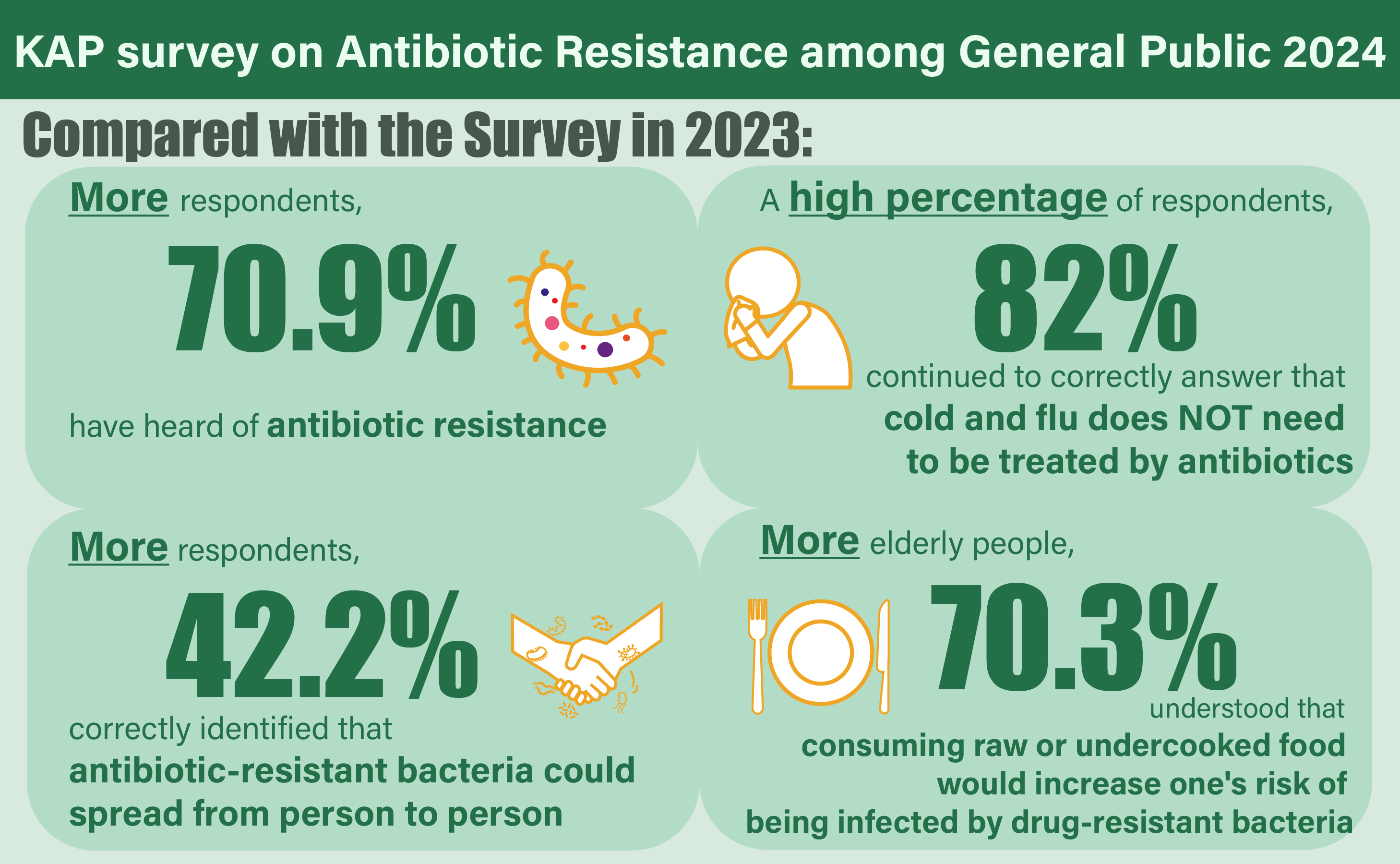
- Compared with 2023, more respondents have heard of the terms “drug-resistant bacteria” (from 66.6% to 70.4%), “antibiotic resistance” (from 66.7% to 70.9%) and “antimicrobial resistance” (from 22.6% to 23.9%).
- The majority of the respondents (82.0%) correctly answered that cold and flu does not need to be treated by antibiotics, which was comparable to 83.8% in 2023 (with no statistically significant difference), and maintained at a high level when compared to 49.7% in 2022.
- The proportion of respondents who correctly identified that antibiotic-resistant bacteria could spread from person to person has slightly increased from 39.2% in 2023 to 42.2% in 2024.
- Subgroup analysis demonstrated improvements in AMR knowledge among the elderly as compared to 2023. For instance, there was increased knowledge that:
- avoiding raw or undercooked ready-to-eat food when taking antibiotics and antacids will reduce the risk of infection by drug-resistant bacteria (from 61.5% to 72.1%),
- cold and flu does not need to be treated by antibiotics (from 81.8% to 83.6%), and
- consuming raw or undercooked food will increase one’s risk of being infected by drug-resistant bacteria (from 62.8% to 70.3%).
- In terms of food safety, less than three-quarter (73.8%) of respondents correctly answered that thorough cooking is effective in killing drug-resistant bacteria in food (71.4% in 2023). Besides, only 65.0% of respondents aged 55 to 64 were aware that avoiding raw or undercooked ready-to-eat food while taking antacid and antibiotic can reduce the risk of drug-resistant bacteria (vs. 76.7% among all age groups).
Summary
The Department of Health has made use of the findings of the 2023 KAP survey to formulate the key messages and promotion strategies for the 2024 World AMR Awareness Week. The 2024 KAP survey results showed improvements in the major gaps identified in the previous survey. This highlights that developing and implementing targeted, evidence-based health promotion programs is effective in increasing public awareness and actions against AMR. The current survey indicated the need for further improvement in public knowledge and practices on food safety to reduce the risk of infection from drug-resistant bacteria in food.
The survey report can be accessed here.