World Immunization Week 2026
2026-04-24
For every generation, vaccines work
Background
The World Health Organization (WHO) celebrated World Immunization Week in the last week of April every year, aiming to promote the use of vaccines to protect people of all ages against vaccine preventable diseases (VPDs). Vaccines have long been one of the most effective tools in public health. Over the last 50 years, vaccines have saved more than 150 million lives. That’s six lives every minute, every day, for five decades. This year’s World Immunization Week theme, “For every generation, vaccines work”, aims to raise awareness that vaccines have safely protected people, families, and communities for generations – and continue to safeguard our future.
With the concerted efforts over the years, the incidence of many VPDs have reduced significantly. Yet, declines in vaccination rates may leave unprotected individuals such as infants and young children more susceptible to infection, leading to serious disease or even death. Take the recent measles outbreaks overseas as an example: due to setbacks in vaccination coverage globally during the COVID-19 pandemic, measles has been re-emerging in many regions worldwide, including North America (such as the United States, Canada, and Mexico) and Southeast Asia (such as Indonesia, Cambodia, and the Philippines), even in some countries that had previously eliminated the disease. The majority of these cases involved individuals who had never been vaccinated against measles or whose vaccination history was unknown, underscoring the importance of maintaining high levels of overall vaccination rates and herd immunity.
#VaccinesWork
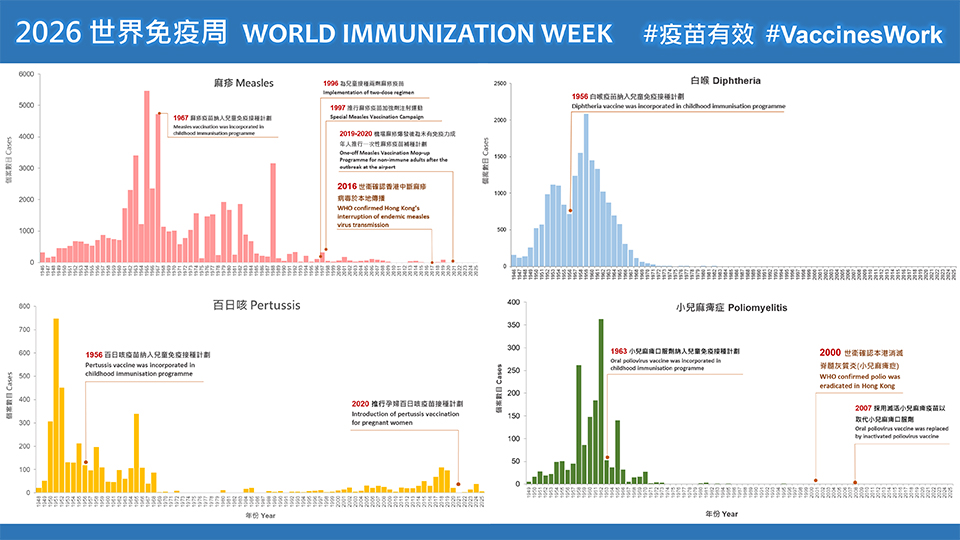
The long-established Hong Kong Childhood Immunisation Programme (HKCIP), coupled with high overall vaccination coverage, has successfully controlled many childhood diseases that were once common in the territory. After global smallpox eradication in 1980, poliomyelitis was eradicated locally in 2000, while measles and rubella were declared eliminated in 2016 and 2021, respectively.
A comprehensive immunisation programme has been provided for all children since the 1960s through Maternal and Child Care Centres and School Immunisation Teams of the Department of Health (DH). As recommended by the Scientific Committee on Vaccine Preventable Diseases under the Centre for Health Protection of the DH, children from birth to primary six currently receive different types of vaccines and boosters under the HKCIP to protect them from tuberculosis, poliomyelitis, hepatitis B, diphtheria, whooping cough (pertussis), tetanus, pneumococcal infection, chickenpox, measles, mumps and rubella. To prevent cervical cancer, eligible female primary school students are provided with human papillomavirus (HPV) vaccine. In addition to these childhood vaccines, the Government also provides immunisation against seasonal influenza, pneumococcal disease and COVID-19 for populations considered at risk of infection.
As delays in vaccination will weaken the protection for the children against relevant infectious diseases, parents are reminded to maintain up-to-date immunisation for their children for timely and comprehensive protection. Parents of preschool children who have not yet received the age-appropriate vaccines are urged to make an appointment at their registered Maternal and Child Health Centres as soon as possible, or consult their family doctors for vaccination. Vaccination under the HKCIP at primary schools will be arranged by the DH's School Immunisation Teams at schools. Parents with children who are currently not residing in Hong Kong are advised to continue immunisation in their place of residence. For vaccines not included in the HKCIP (e.g. meningococcal vaccine), parents should seek professional advice from doctors to arrange vaccination for their children. Doctors will take into account their age, health conditions, and details of their journeys (including destination, duration and activities) when giving vaccination advice.
Members of the public who are planning to travel to places with high incidence or outbreaks of vaccine preventable diseases (e.g. measles, pertussis) should review their vaccination history and past medical history, especially non-local born people who might not have received their vaccinations during childhood. For those with incomplete vaccination, unknown vaccination history or unknown immunity, they are urged to consult their doctor for advice on vaccination before departure.
Catch-up vaccinations are advised for immigrants, overseas students or migrant workers with unknown immune status, uncertain or incomplete vaccination status, preferably prior to their arrival.